
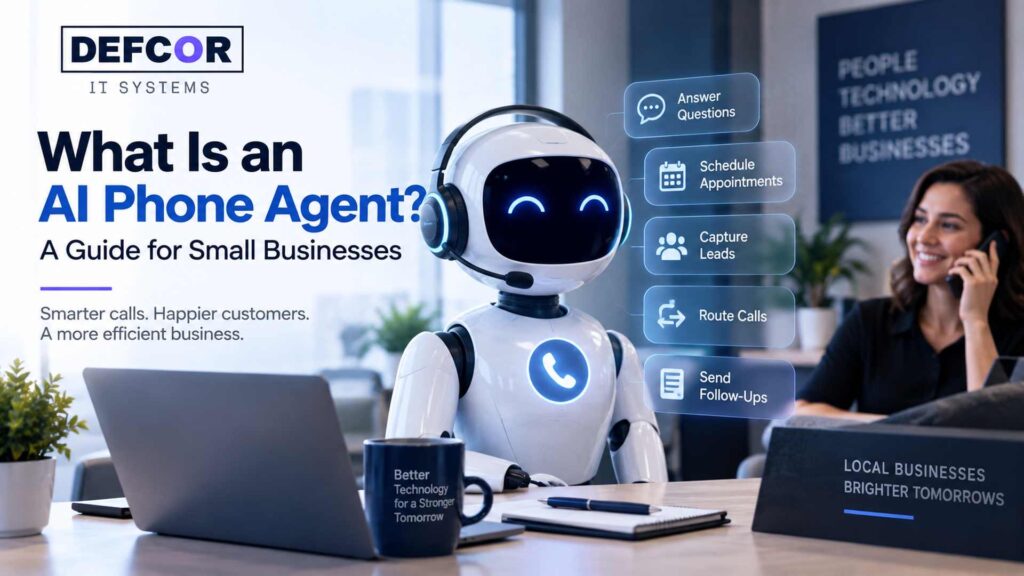
A customer calls while your team is helping someone else, driving to a job, or finishing work after hours. Traditionally, that call may go to voicemail, interrupt an employee, or reach an answering service that can only take a message. An AI phone agent creates another option: software that can hold a spoken conversation, understand what the caller needs, follow business rules, and take approved actions.
So, what is an AI phone agent in practical terms? It is a voice-based AI system built to handle business phone conversations. Depending on its setup, it can answer routine questions, collect lead details, schedule appointments, route calls, create summaries, trigger follow-up, and transfer situations that need human judgment. For a small business, the goal is to handle predictable phone work while keeping people involved where judgment, empathy, or expertise matters.
What Can an AI Phone Agent Actually Do?
The key difference from older telephone automation is how an AI phone agent handles natural speech and context. Traditional interactive voice response usually asks callers to press numbers or choose a fixed menu. A modern voice agent can interpret natural speech and conversational context without forcing every caller through the same decision tree.
Its capabilities depend on the knowledge, integrations, permissions, and rules configured for the business. Common tasks include:
- answering questions about hours, locations, services, service areas, and basic policies;
- collecting a caller’s name, contact details, needs, location, or other intake information;
- checking availability and requesting or booking an appointment when connected to an appropriate calendar;
- qualifying leads using predefined criteria and routing priority opportunities;
- creating call summaries or triggering text, email, CRM, and follow-up workflows.
Different Levels of AI Autonomy
An “AI phone agent” does not describe one fixed level of autonomy. One system may only answer questions and capture messages; another may be authorized to check calendars, create appointments, update records, or initiate follow-up. Compare what an agent is actually permitted to do, not just its label.
How AI Phone Agents Work Behind the Conversation
Understanding how AI phone agents work is easier when you view a call as a sequence. The phone system passes call audio into the voice-AI workflow. Speech recognition converts the caller’s words into processable information. An AI model interprets intent and context, while business instructions and approved knowledge guide the response. Speech synthesis turns that response back into spoken audio.
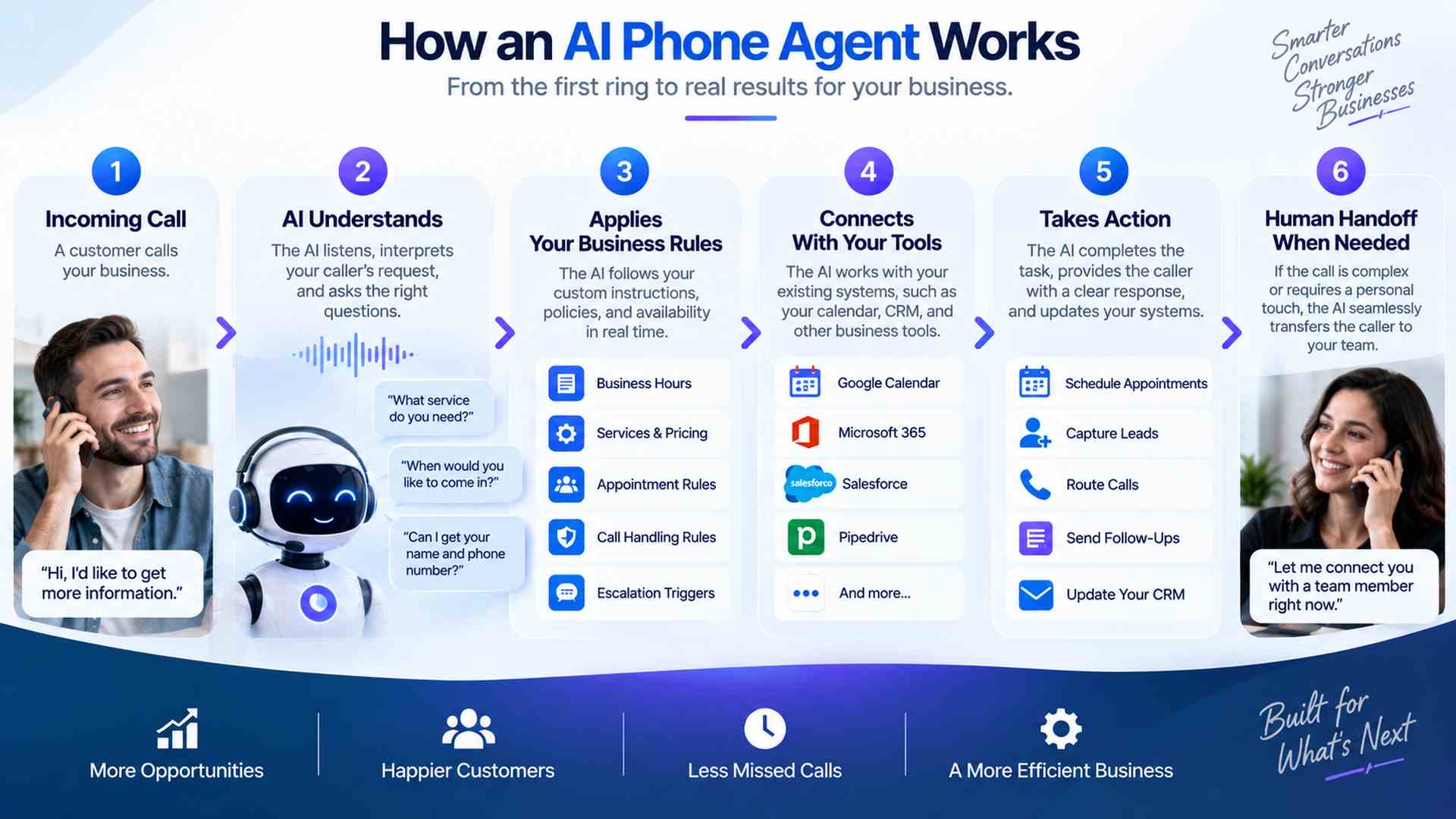
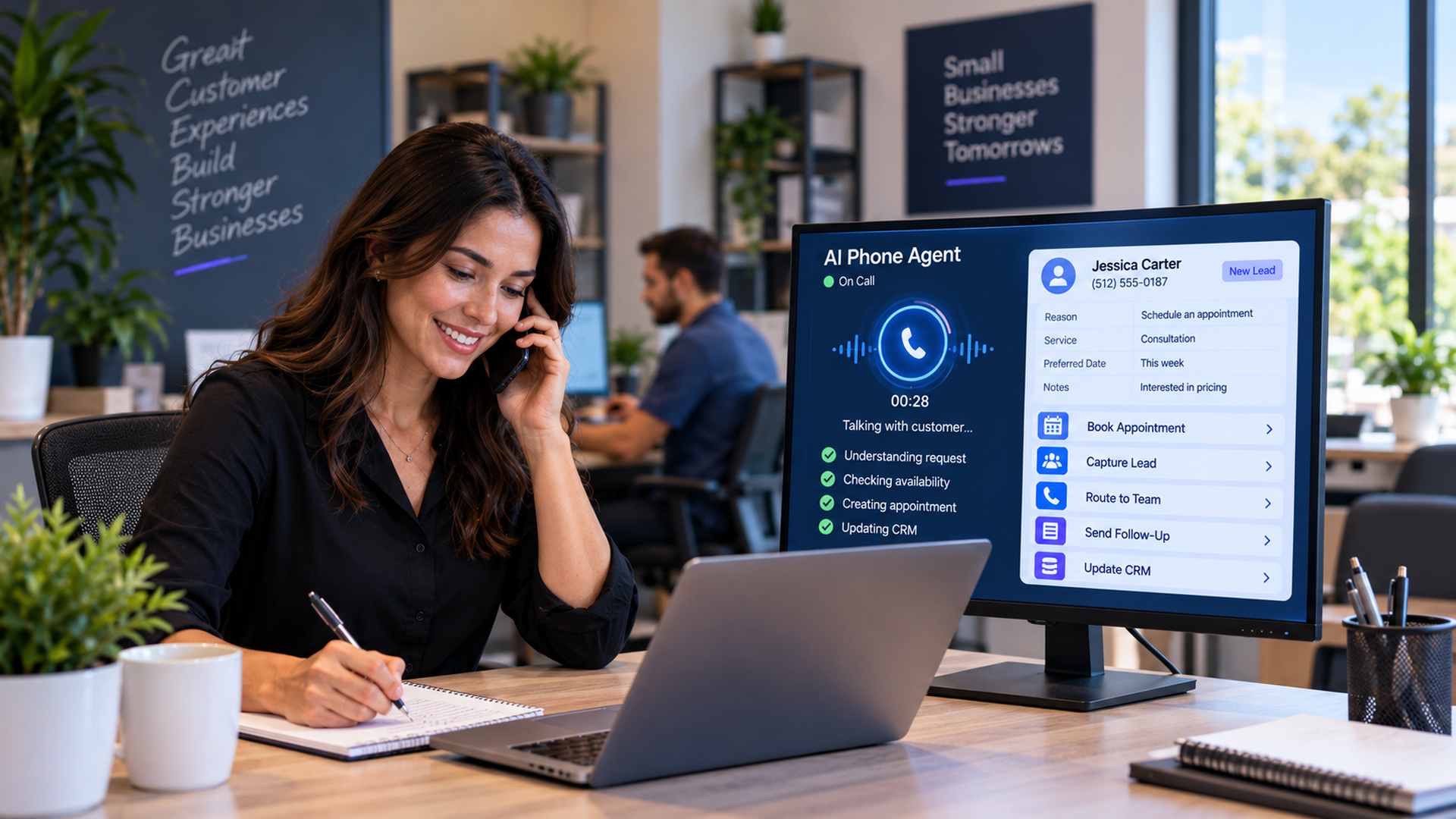
Beyond the conversation itself, the agent may connect to a calendar, CRM, dispatch platform, forms, or other systems, allowing a conversation to trigger an approved business action. For an appointment request, for example, it might collect required details, check available times, create the booking, and send a confirmation instead of leaving a message for an employee.
The technology is only part of the result. Knowledge sources, call flows, permissions, escalation rules, and testing can change how the same type of system performs. Start with the workflow: Which calls repeat? What information is required? What is safe to automate? When must a person take over?
AI Phone Agent vs. AI Answering Service
The terms overlap, but they don’t always describe the same scope. An AI answering service may primarily answer incoming calls, provide basic information, and take messages. A phone agent can describe a broader system that combines conversation with workflow actions and may support inbound or outbound calling.
A basic answering system might capture a caller’s name, number, and reason for calling after hours. A more integrated agent could gather required information, check availability, create an appointment, update the CRM, and send confirmation when those actions are authorized.
When comparing solutions, the definition matters less than what happens after “hello.” Ask what the system can access, which actions it can take, how it handles uncertainty, and how callers reach a person.
What a Real AI Phone Call Can Look Like
Consider a Texas HVAC company receiving a call at 7:40 p.m. A homeowner says the air conditioner has stopped cooling. The agent asks for the caller’s name, address, ZIP code, and a description of the problem. It confirms the address is within the service area, checks the next available appointment window, records the request, and sends a confirmation. The team starts the next morning with structured information instead of an unreviewed voicemail.
Routine Calls vs. Safety Exceptions
Now change one detail: the caller reports smelling gas. The normal scheduling flow should not continue as though this were an ordinary repair request. The agent should follow predefined safety and escalation instructions rather than improvise.
That distinction is central to AI phone agents for small businesses: automation works best when the routine path is clear and exceptions have a safe destination.
Where AI Phone Agents for Small Businesses Make Sense
The strongest use cases involve repeatable conversations with clear rules. A home-service company may automate service-area and scheduling questions. A property manager may separate routine after-hours maintenance from emergencies. A clinic may automate scheduling while directing medical concerns to qualified staff.
DEFCOR’s AI phone agent services illustrate how call handling can support intake, after-hours requests, qualification, summaries, and follow-up.
Good Tasks for AI vs. Tasks That Need Human Judgment
Good automation candidates are usually frequent, structured, and governed by clear rules: “What time do you close?”, “Do you serve my ZIP code?”, “Can I request an appointment tomorrow?”, or “Please take my contact information.”
Human involvement matters more for complaints, negotiations, sensitive disputes, emergencies, unusual pricing decisions, or professional judgment. A well-designed agent doesn’t need to finish every call; it needs to recognize when the correct next action is a human handoff.
Business Benefits and the Limits
For many owners, the real question is whether the technology solves a meaningful operational problem. Potential benefits include more consistent call coverage, structured intake, faster handling of routine requests, and less repetitive administrative work. It can also capture information outside normal hours without continuous employee monitoring.
Understanding the limitations matters just as much as understanding the capabilities: AI can misunderstand speech, encounter questions outside its approved knowledge, or face situations where the correct response depends on context. Background noise, emotional callers, ambiguous requests, and exceptions can make conversations harder.
A safe transfer can be a successful outcome when a conversation moves beyond the agent’s defined role—and that’s a useful boundary, not a failure.
Integration, Security, and Privacy Need to Be Designed In
A practical question that is easy to overlook is how much access the agent should have. Before connecting a voice agent to business systems, decide what data and permissions it genuinely needs. Message-taking requires different access from reading customer records or changing appointments.
Outbound use may introduce additional consent and calling-rule requirements, so businesses should review applicable regulations before automating those workflows.
Implementation should consider authentication, access controls, data retention, applicable call-recording requirements, vendor security practices, and sensitive information. Regulated businesses may have additional obligations and should evaluate both vendor and workflow accordingly.
If the agent writes to a CRM, fields should match the team’s process. If it schedules appointments, rules for availability, duration, locations, cancellations, and exceptions must be accurate. Understanding how AI phone agents work before granting access helps prevent unnecessary permissions and poorly defined actions.
DEFCOR’s business technology articles provide broader context on AI and digital operations that intersect with customer communication.
How to Evaluate an AI Phone Agent Before Deployment
Before deployment, skip the perfect demo script and test the agent with realistic calls. Include ordinary requests, interruptions, unclear answers, background noise, unexpected questions, and situations that should trigger escalation.
Pay particular attention to three areas:
- Accuracy: Does the agent rely on approved business information and avoid inventing answers?
- Action handling: Does it schedule, write, route, or notify correctly when connected systems are involved?
- Human handoff: Can callers reach a person without getting trapped in a conversation the AI cannot resolve?
Also test integration failures and situations where required information is unavailable. The agent needs a defined fallback rather than pretending an action succeeded. After launch, permitted call summaries or transcripts can reveal failures and new caller questions.
Is an AI Phone Agent Right for Your Small Business?
AI phone agents for small businesses are worth considering when missed calls, repetitive intake, after-hours inquiries, or manual follow-up create a real operational problem. They are less compelling when call volume is tiny, conversations are almost always complex, or nearly every interaction requires specialized judgment.
If you mainly need message capture, a simpler AI answering service may be enough. If calls need to lead into scheduling, qualification, CRM updates, routing, or follow-up, a more integrated agent may make sense.
A Three-Question Automation Test
To decide where an AI phone agent fits in your business, review one week of calls and classify each type with three questions:
- Is this conversation frequent or repetitive?
- Does the correct response or next action follow clear rules?
- If something goes wrong, does the situation require significant human judgment?
Calls that score strongly on the first two questions and low on the third are often better automation candidates. Calls involving exceptions, emotion, safety, negotiation, or professional judgment should have a human path.
Final Thoughts
For Texas businesses exploring voice AI, DEFCOR works across AI automation, IT, and related business systems. The best next step is not to automate for the sake of it. Identify one communication bottleneck, decide what the agent may handle, limit its access to what it actually needs, and design the human handoff before deployment. That gives the business a practical way to judge whether voice AI fits its customers, staff, and day-to-day operations.